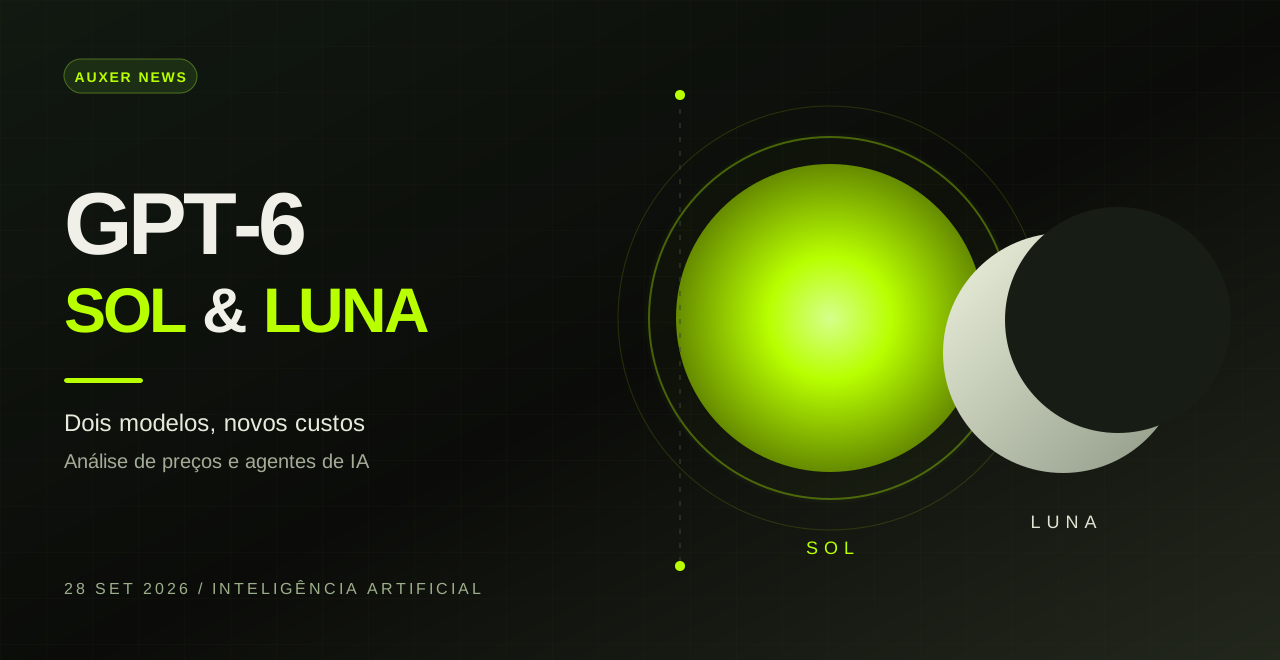
On September 22, 2026, OpenAI introduced GPT-6 Sol and GPT-6 Luna. The models join GPT-6 Astra with a proposition that matters to product builders: run AI workloads at different levels of capability and cost. According to OpenAI, API prices for Sol and Luna are approximately 50% lower than the corresponding promotional GPT-5.6 prices.
This is more than another model launch. Lower prices, better caching and a broader choice of capabilities give teams a reason to revisit the economics of assistants, coding agents and applications that make large numbers of API calls. Yet cheaper tokens do not necessarily mean cheaper completed tasks. Answer quality, retries and context size still determine the final bill.
GPT-6 Sol vs. Luna: what is the difference?
OpenAI positions Sol for more demanding professional work and coding, while Luna focuses on efficiency for frequent tasks and scaled applications. Astra remains the family's most capable model, according to the company. That gives engineering teams a design choice: allocate more capability to difficult steps and use less expensive models where they meet the required quality bar.
The published API model IDs are gpt-6-sol and gpt-6-luna. Both support text and image inputs and generate text through the Responses and Chat Completions APIs, according to OpenAI's official changelog.
What do the new models cost?
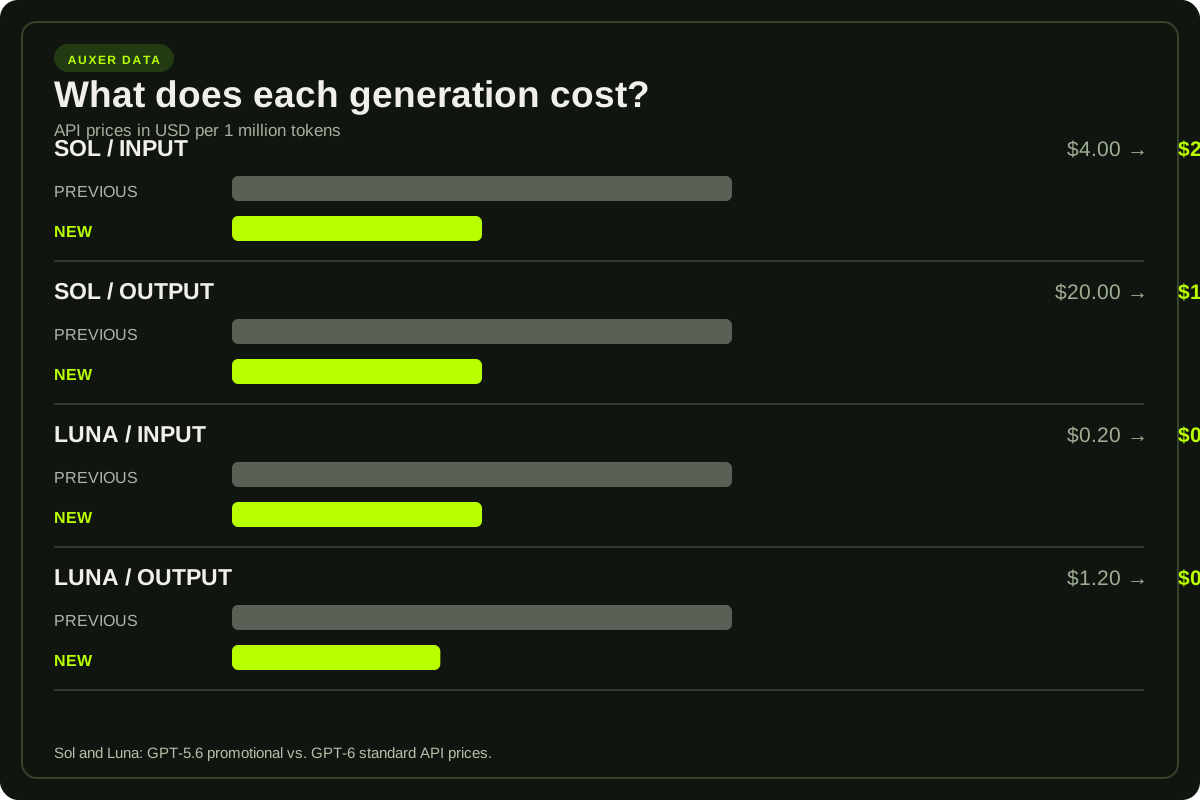
OpenAI lists the following standard API prices for prompts with up to 272,000 input tokens, in US dollars per 1 million tokens:
| Model | Input | Cached input | Output |
|---|---|---|---|
| GPT-6 Sol | $2.00 | $0.20 | $10.00 |
| GPT-6 Luna | $0.10 | $0.01 | $0.50 |
These are standard API prices announced on September 22. Longer prompts, cache writes and other processing tiers may be priced differently. The announced reduction compares the new models with GPT-5.6 promotional pricing, not ChatGPT subscription prices.
The split between input and output matters. An agent that reads a large codebase may be input-heavy; a content-generation application may spend more on output. Teams should measure their actual token mix before choosing a model solely on its input price.
Prompt caching could matter as much as the price cut
OpenAI also announced improvements to prompt caching for GPT-6. Eligible shared prefixes reused within a 30-minute window can benefit from previous processing. The company reports a 90% discount on cached input-token reads and has introduced tools to monitor cache hit rates and diagnose missed reuse.
That is particularly useful for agents that repeatedly send instructions, tool definitions and long conversation histories. Instead of hoping that similar requests are processed efficiently, developers can inspect cache metrics and structure prompts to make repeated context more reusable.
- Keep prefixes stable: preserve the structure and order of instructions and tool definitions that rarely change.
- Investigate misses: changes to the model, tools or input may prevent cache reuse.
- Measure the full result: track cache hits, latency, total cost and answer quality against the same set of tasks.
The discount applies to tokens actually served from cache, not automatically to every input token. The total charge depends on the composition of each request.
An important update for image-based applications
OpenAI's API changelog records a September 25 fix for an image-encoding issue that degraded visual understanding in Sol and Luna. Its guidance is to rerun evaluations and retry affected workflows, particularly those relying on image input or computer use. Launch benchmarks are useful reference points, but they cannot replace tests in your own application.
What should developers and businesses do next?
The compelling opportunity is to route work by difficulty. A team might test Luna for classification, extraction and routine responses; Sol for coding and more complex analysis; and a higher-capability model for exceptions that demand it. This is an engineering strategy to validate, not a guarantee that any particular model will suit every task in those categories.
Start with a small evaluation set drawn from real production requests. Compare completion quality, latency and cost per finished task before changing your routing strategy. Include retries, tool failures and manual corrections. A cheap call that must be repeated several times may turn out to be expensive work.
GPT-6 Sol and Luna make it more affordable to experiment with AI at scale. Turning lower token prices into a sustainable product still takes careful evaluation, observability and sound architecture.
Sources
- OpenAI: Introducing GPT-6 Sol and Luna (September 22, 2026).
- OpenAI API: official changelog (September 22 launch and September 25 image fix).
- OpenAI: Better prompt caching for GPT-6 (September 22, 2026).